

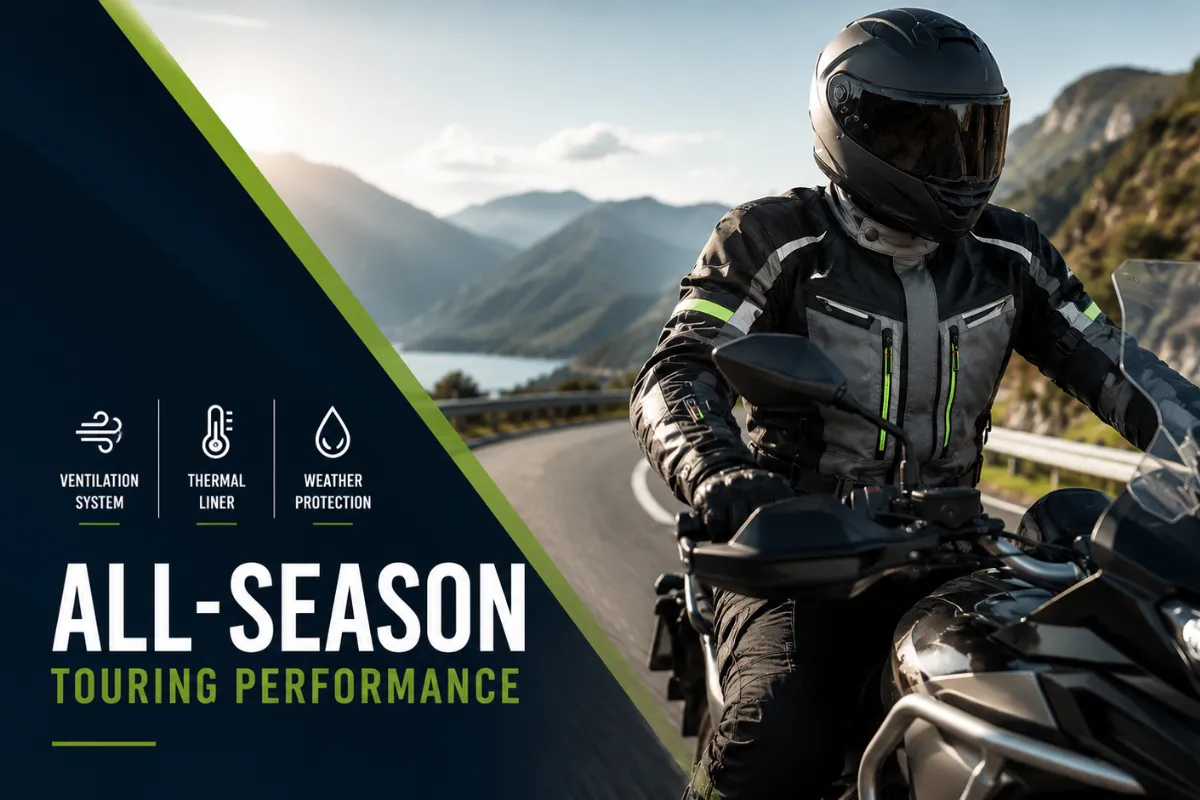
Introduction
Designing a motorcycle jacket that performs properly in different weather conditions is far more complex than most buyers initially realise.
Many products in the market are labelled as “all-season touring jackets”, but when riders begin using them in real-world conditions, performance issues quickly become obvious. Some jackets become extremely hot during summer riding, while others fail to provide enough insulation in colder environments. In many cases, jackets marketed as waterproof also trap heat and moisture inside, making long-distance riding uncomfortable.
For motorcycle brands, wholesalers, importers, and private label businesses, these issues create serious commercial problems:
| Common Problem | Business Impact |
| Poor ventilation | Customer complaints during summer use |
| Weak insulation | Negative reviews in colder regions |
| Low-quality waterproofing | Product returns and warranty claims |
| Heavy construction | Reduced rider comfort |
| Poor climate adaptability | Weak long-term brand trust |
An effective all-season touring motorcycle jacket is not simply a jacket with vents and a removable liner. It is a carefully engineered product designed to manage:
- Airflow
- Heat retention
- Moisture control
- Weather protection
- Rider comfort during long-distance touring
Every technical component inside the jacket must work together correctly. If one system performs poorly, the overall rider experience is affected.
This guide explains in simple and practical terms how professional all-season touring motorcycle jackets are developed, how ventilation and thermal systems function, and what buyers should understand before sourcing or developing products for their own brand.
What Makes a Motorcycle Jacket Truly “All-Season”?
Understanding Real All-Season Performance
An all-season touring jacket is designed to adapt to changing weather conditions while maintaining rider comfort and protection.
This means the jacket should perform effectively in:
| Riding Condition | Performance Requirement |
| Hot summer riding | Maximum airflow and heat release |
| Cold-weather touring | Thermal insulation and wind blocking |
| Rainy conditions | Moisture protection |
| Long-distance highway riding | Comfort and climate balance |
To achieve this, the jacket must carefully balance:
- Ventilation
- Insulation
- Waterproofing
- Breathability
- Ergonomic comfort
Why Many Touring Jackets Fail in Real Riding Conditions
A jacket may look highly technical from the outside, but appearance alone does not guarantee performance.
Many lower-quality touring jackets fail because:
| Common Design Problem | Result for Riders |
| Decorative vents without airflow engineering | Heat build-up |
| Thick liners without breathability | Excess sweating |
| Poor-quality waterproof coating | Moisture discomfort |
| Heavy fabric layering | Reduced mobility |
| Weak internal airflow system | Poor long-distance comfort |
As a result, riders often experience:
- Overheating during summer rides
- Sweat accumulation inside the jacket
- Reduced comfort on long-distance journeys
- Difficulty adapting to changing weather conditions
For brands targeting touring and adventure riders, these factors directly influence customer satisfaction and repeat purchases.
If you want to understand premium construction standards in greater detail, our guide on “What Makes a High-Quality Motorcycle Jacket?” explains how materials, reinforcements, stitching quality, and safety-focused construction affect overall product performance.
Ventilation System Design – How Airflow Actually Works
Why Ventilation Is Critical in Touring Jackets
One of the biggest challenges in motorcycle jacket design is controlling body temperature during riding.
While riding, especially over long distances, body heat builds up quickly inside the garment. Without proper airflow, the rider becomes uncomfortable, fatigued, and distracted.
A professional touring jacket is designed to move air through the garment in a controlled way.
This is very different from simply adding a few visible zip openings.
Air Intake Vents – Bringing Cool Air Inside
Air intake vents are positioned to capture airflow while the rider is moving.
These vents are commonly placed on:
- Chest panels
- Upper sleeve areas
- Forearms
Their function is to pull cool outside air into the jacket.
Exhaust Vents – Releasing Trapped Heat
Exhaust vents are usually located on:
- Upper back panels
- Shoulder blade areas
Their role is to release hot air trapped inside the jacket.
Without exhaust vents, airflow cannot circulate properly.
How a Balanced Ventilation System Works
| Vent Type | Common Placement | Main Function |
| Intake vents | Chest and sleeves | Pull cool air inside |
| Exhaust vents | Upper back | Release hot air |
| Mesh airflow lining | Internal torso area | Circulate airflow across the body |
Why Vent Placement Matters
A professional airflow system requires balance.
If a jacket includes intake vents but lacks proper exhaust channels:
- Air becomes trapped inside
- Heat accumulates rapidly
- Moisture cannot escape effectively
This is why high-quality touring jackets use engineered airflow mapping based on:
- Riding posture
- Wind direction during riding
- Heat concentration zones on the body
Waterproof Vent Construction
Modern touring jackets often include:
- Waterproof coil zippers
- Mesh-backed vent systems
- Rain-shed protective flaps
This allows airflow while reducing the risk of water entering the garment during rain.
Buyer Insight
Many lower-cost motorcycle jackets include visible vent zippers mainly for appearance. However, without internal airflow engineering, these vents provide very limited practical cooling performance.
For brands targeting touring and adventure riders, airflow performance should be considered a core technical feature rather than a cosmetic detail.
For examples of export-grade touring constructions, you can also explore our Motorbike Jackets collection, developed for long-distance riding performance and professional OEM manufacturing.
Mesh Airflow Channel Systems – The Real Secret Behind Cooling Performance
What Is an Airflow Channel System?
One of the most important features inside a premium touring motorcycle jacket is the internal airflow channel system.
This system controls how air moves through the jacket while riding.
The airflow process works like this:
Front intake vents
→ cool air enters the jacket
→ internal mesh channels distribute airflow
→ rear exhaust vents release trapped heat
This creates continuous ventilation during riding.
Internal Mesh Construction
Professional touring jackets commonly use:
| Material Type | Purpose |
| 3D spacer mesh | Creates airflow space between body and fabric |
| Polyester air mesh | Improves ventilation |
| Sandwich mesh lining | Enhances airflow distribution |
These materials create small air gaps between the rider’s body and the outer shell fabric, improving:
- Air circulation
- Sweat evaporation
- Cooling efficiency
- Riding comfort
Real-World Benefits for Riders
A properly engineered airflow system helps riders:
| Benefit | Rider Advantage |
| Reduced heat build-up | Greater comfort in warm weather |
| Improved sweat management | Reduced moisture discomfort |
| Better airflow circulation | Improved long-distance usability |
| Controlled cooling | Less rider fatigue |
Ventilation System Comparison
| Feature | Basic Vent Design | Engineered Airflow System |
| Air circulation | Limited | Continuous |
| Heat management | Weak | Effective |
| Moisture control | Minimal | Strong |
| Rider comfort | Average | High |
| Touring suitability | Low | Excellent |
Buyer Insight
The quality of airflow inside a motorcycle jacket depends far more on internal airflow engineering than the number of visible vents.
This is one of the biggest differences between entry-level products and premium touring apparel.
Removable Thermal Liners – How Touring Jackets Handle Cold Weather
Why Thermal Liners Matter
Touring riders often encounter changing temperatures during long-distance journeys.
A rider may begin the day in cold weather and later travel through warmer environments. Because of this, flexibility is extremely important.
Thermal liners help retain body heat during:
- Winter riding
- Cold mornings
- Mountain touring
- Long motorway journeys
Common Thermal Liner Materials
Professional touring jackets commonly use:
| Material | Purpose |
| Polyester taffeta | Lightweight liner shell |
| Fibre-fill insulation | Heat retention |
| Quilted construction | Even insulation distribution |
Thermal insulation levels are usually measured in GSM (grams per square metre).
Understanding GSM in Thermal Liners
Higher GSM generally means greater insulation.
| GSM Range | Insulation Level | Recommended Use |
| 60-80 GSM | Light insulation | Mild weather |
| 80–120 GSM | Medium insulation | All-season touring |
| 120+ GSM | Heavy insulation | Winter-focused products |
Removable vs Fixed Thermal Liners
| Feature | Removable Liner | Fixed Liner |
| Seasonal flexibility | High | Low |
| Rider comfort | Better | Limited |
| Touring suitability | Excellent | Moderate |
| Production cost | Higher | Lower |
Why Removable Liners Are Preferred
Removable thermal liners allow riders to:
- Adapt to changing weather
- Reduce jacket weight in warm conditions
- Improve comfort during multi-season riding
For UK and European touring markets, removable thermal systems are now commonly expected in premium and mid-range motorcycle jackets.
Waterproof vs Water-Resistant Motorcycle Jackets
Understanding the Difference
This is one of the most misunderstood areas in motorcycle apparel sourcing.
A water-resistant jacket and a waterproof jacket are not the same product.
Water-Resistant Construction
Water-resistant jackets typically include:
- DWR-coated fabrics
- Water-resistant zippers
- Basic rain protection systems
Suitable for:
- Light rain
- Short-distance riding
Waterproof Construction
Fully waterproof jackets usually include:
- Waterproof membrane layers
- Sealed seam construction
- Advanced moisture barriers
Suitable for:
- Heavy rain
- Long-distance touring
- Extended outdoor use
Waterproof vs Water-Resistant Comparison
| Feature | Water-Resistant | Waterproof |
| Light rain protection | Yes | Yes |
| Heavy rain protection | Limited | Strong |
| Breathability | Better | Moderate |
| Moisture resistance | Basic | Advanced |
| Cost | Lower | Higher |
Common Buyer Mistake
Many buyers assume that PU-coated fabric automatically means the jacket is waterproof.
This is incorrect.
True waterproof performance requires:
- Membrane integration
- Sealed seams
- Multi-layer moisture protection systems
Buyer Insight
One of the biggest challenges in touring jacket engineering is balancing waterproof protection with breathability.
Excessive waterproofing without proper airflow often creates overheating problems during active riding.
For buyers developing high-performance touring products, our Cordura motorcycle jackets are specifically designed for abrasion resistance, weather protection, and long-distance riding durability. Airflow channel systems help move cool air through the jacket and release trapped heat, improving comfort during long-distance riding.
FAQ
An all-season motorcycle jacket combines ventilation systems, thermal liners, and weather protection to perform across different climates and riding conditions.
Airflow channel systems help move cool air through the jacket and release trapped heat, improving comfort during long-distance riding.
Water-resistant jackets provide protection against light rain, while waterproof jackets use membrane systems and sealed seams for heavy rain protection.
For all-season touring jackets, 80–120 GSM insulation is commonly used because it balances warmth, flexibility, and rider comfort.
Yes. Removable thermal liners provide greater flexibility, allowing riders to adapt the jacket for both warm and cold weather conditions.