

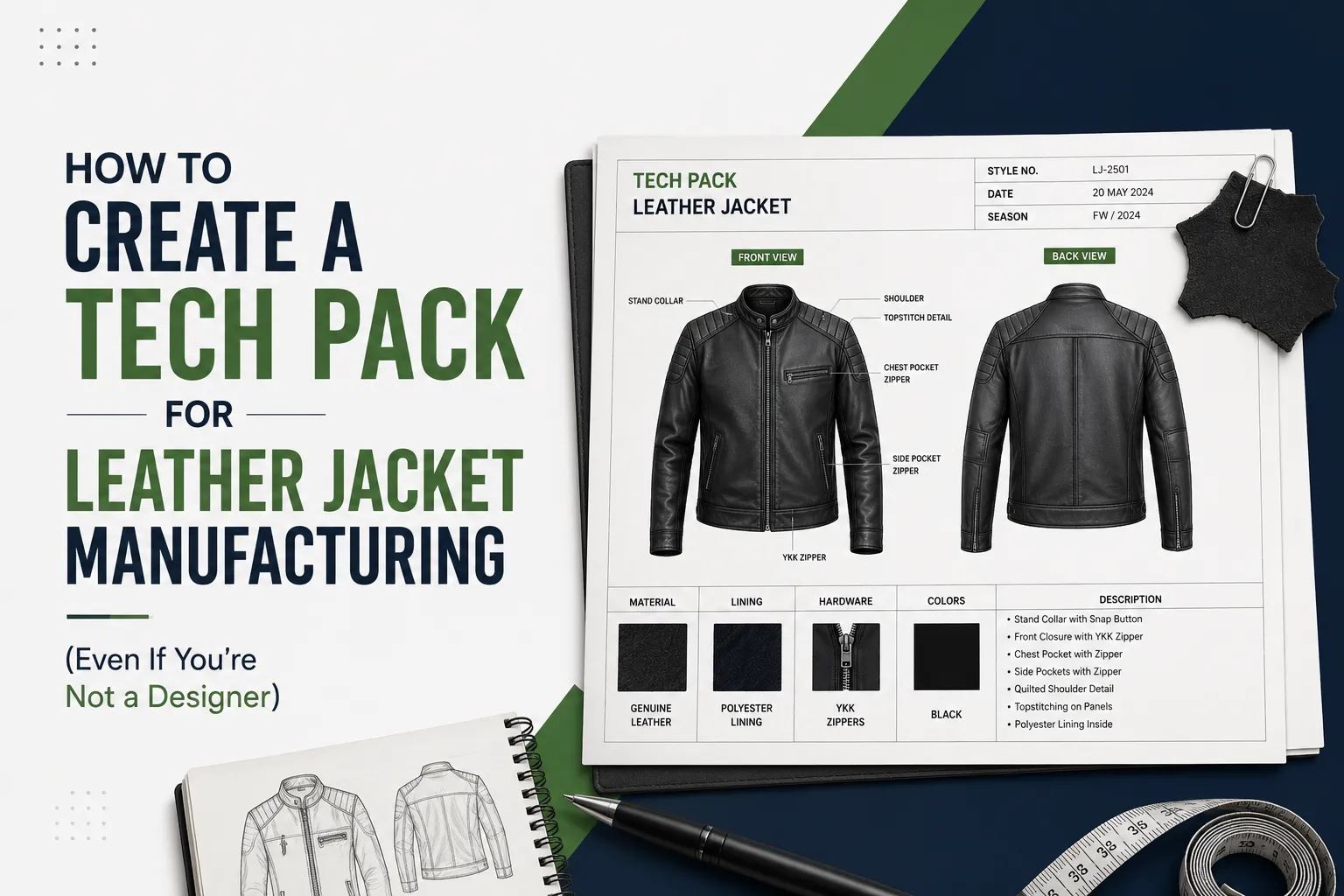
If you’ve never developed a leather jacket before, you’ve probably come across the term “tech pack.”
For many first-time brand owners, it sounds like something only fashion designers or large apparel companies use.
As a result, some buyers delay contacting manufacturers because they believe they need a perfect technical document before starting the conversation.
From our experience, that’s one of the biggest misconceptions in product development.
Some of the most successful projects we’ve worked on didn’t begin with a professionally designed tech pack.
They started with a simple idea.
Sometimes a buyer shared a hand-drawn sketch. Others sent inspiration images they had saved over the years. Some already owned a jacket they liked and wanted to create something similar with their own branding and improvements.
What mattered wasn’t the format of the information.
What mattered was having enough details to understand the vision behind the product.
A tech pack isn’t created to make the manufacturing process more complicated.
It’s created to remove uncertainty.
When both the buyer and the manufacturer clearly understand the product before sampling begins, the entire development process becomes smoother.
There are fewer misunderstandings, fewer revisions, more accurate quotations, and a much better chance of approving the first sample quickly.
In this guide, we’ll explain what a leather jacket tech pack actually does, what information manufacturers need before developing a sample, and what you can do if you don’t have a professional tech pack yet.
If you’re planning to launch your own leather jacket brand or expand your existing collection, this guide will help you approach product development with greater confidence.
Before You Start Designing, Understand Why a Tech Pack Matters
Many buyers think a tech pack is simply another document manufacturers ask for before production.
In reality, it’s the foundation of every successful product development project.
Think of it this way.
Imagine asking three different manufacturers to produce the same leather jacket using nothing more than a few reference photos.
Each manufacturer would likely interpret the design differently.
One might use thicker leather.
Another might select a different lining.
The pocket dimensions could vary.
Even the jacket fit might change because no measurements were defined.
Although everyone is trying to manufacture the same product, each factory is making decisions based on assumptions.
That uncertainty is exactly what a tech pack is designed to eliminate.
Instead of leaving room for interpretation, it provides clear instructions that guide every stage of sampling and production.
| Without a Clear Tech Pack | With a Well-Prepared Tech Pack |
| Manufacturers interpret the design differently | Everyone works from the same product specifications |
| Sampling often requires multiple revisions | Sample development becomes faster and more accurate |
| Quotations may vary significantly | Pricing is based on clearly defined requirements |
| Quality can differ between production runs | Manufacturing becomes more consistent |
| Communication takes longer | Questions are resolved before production starts |
A well-prepared tech pack doesn’t guarantee perfection.
However, it gives your manufacturer the information needed to make informed decisions instead of educated guesses.
That saves time for both sides and helps reduce avoidable production issues.
What Information Should a Leather Jacket Tech Pack Include?
One of the most common questions we receive from new buyers is:
“What exactly should I include in my tech pack?”
There isn’t a universal template that works for every jacket.
A minimalist bomber jacket and a protective motorcycle jacket require different technical information.
However, every production-ready tech pack should answer one important question:
If someone has never seen your jacket before, would they have enough information to manufacture it correctly?
Let’s look at the essential sections.
1. Design Sketches
Every project begins with a visual concept.
This doesn’t mean you need professionally illustrated fashion drawings.
Your sketches simply need to communicate what you’re trying to build.
A complete design concept usually includes:
- Front view.
- Back view.
- Close-up details of important features.
- Pocket placement.
- Collar style.
- Sleeve construction.
- Cuff design.
If you don’t have sketches, clear reference photographs with written notes can also be helpful during the early development stage.
The clearer your design direction is, the easier it becomes for your manufacturer to understand your expectations.
2. Measurements and Size Specifications
A beautiful jacket that doesn’t fit properly is unlikely to satisfy your customers.
That’s why measurements are one of the most important parts of a tech pack.
Your size specifications should explain how you want the finished jacket to fit.
Depending on your collection, this may include:
- Chest measurement.
- Shoulder width.
- Sleeve length.
- Body length.
- Hem width.
- Collar dimensions.
- Cuff opening.
It’s also important to define your target fit.
For example:
- Slim fit.
- Regular fit.
- Relaxed fit.
- Oversized fit.
Small measurement changes can completely alter how a jacket feels when worn.
Providing clear sizing information from the beginning helps reduce fitting revisions during sampling.
3. Leather Selection
Choosing the right leather is about much more than appearance.
It influences manufacturing cost, customer experience, durability, and the position your brand occupies in the market.
Your tech pack should specify:
- Preferred leather type.
- Desired leather thickness.
- Surface finish.
- Colour requirements.
- Texture preferences.
If you’re still deciding which leather best suits your collection, our guide Best Leather Types for Premium Jacket Brands explains how different leather options influence pricing, durability, customer expectations, and brand positioning.
Rather than choosing the most expensive material, focus on selecting the leather that matches your target market and the experience you want your customers to have.
4. Hardware Specifications
Many buyers underestimate how much hardware contributes to the overall quality of a leather jacket.
Customers interact with these components every time they wear the product.
Your tech pack should identify details such as:
- Zipper type.
- Metal finish.
- Buttons.
- Snaps.
- Buckles.
- Rivets.
- Pullers.
If you have a preferred hardware supplier or brand, include that information as well.
Consistent hardware selection helps ensure that every production run maintains the same quality standard and visual appearance.
In the next section, we’ll cover the remaining elements of a professional tech pack, including lining materials, stitching details, branding requirements, artwork files, common mistakes that delay sampling, and what you can send if you don’t yet have a complete tech pack.
5. Lining Materials and Interior Construction
When buyers evaluate a sample for the first time, they usually focus on the leather. However, once the jacket is worn, the lining becomes just as important.
The lining affects comfort, warmth, breathability, and the overall wearing experience. Choosing the right lining should always depend on how your customers will use the jacket rather than selecting the least expensive option.
For example, a lightweight fashion jacket may require a smooth satin or polyester lining, while a winter jacket may need quilted padding for additional insulation. Motorcycle jackets may also require breathable linings that improve comfort during long rides.
Your tech pack should clearly specify:
- Lining material
- Lining color
- Padding requirements
- Pocket lining
- Inside pocket construction
- Special performance requirements
| Lining Option | Best For | Customer Experience |
| Polyester | Everyday fashion jackets | Lightweight and durable |
| Satin | Premium fashion collections | Smooth and luxurious feel |
| Quilted lining | Winter leather jackets | Better insulation and warmth |
| Mesh lining | Motorcycle jackets | Improved airflow and breathability |
The better you define your lining requirements, the easier it becomes to produce a jacket that matches your customers’ expectations.
6. Stitching and Construction Details
Two leather jackets may use the same leather and hardware but still differ significantly in quality because of how they are constructed.
Construction details determine how well the jacket performs over time.
Your tech pack should include information such as:
- Top stitching locations
- Seam construction
- Reinforcement areas
- Thread color
- Stitch density
- Decorative stitching requirements
These details may seem minor, but they influence durability, consistency, and the overall appearance of the finished garment.
For motorcycle jackets, reinforced stitching in high-stress areas is particularly important because it improves strength where the garment experiences the greatest movement.
7. Branding Requirements
Private label manufacturing is where your product begins to represent your business rather than the factory that produced it.
Branding is much more than adding a logo.
Every branding element contributes to how customers recognize and remember your brand.
Your tech pack should specify every branded component you want included.
| Branding Element | Purpose |
| Woven neck label | Displays your brand identity |
| Care label | Provides fabric and care information |
| Size label | Improves inventory management |
| Hang tag | Creates a professional retail presentation |
| Embroidery | Adds premium visual branding |
| Embossed leather patch | Strengthens brand recognition |
| Custom packaging | Enhances the unboxing experience |
If you’re planning to launch your own collection, we recommend reading our guide Private Label Leather Jacket Manufacturing: From Design Concept to Bulk Production, where we explain how branding is integrated throughout the manufacturing process.
8. Logo Files and Artwork
Many production delays occur simply because artwork files aren’t suitable for manufacturing.
Whenever possible, provide your logo in vector formats such as AI, EPS, or PDF. These files allow manufacturers to scale your artwork without losing quality.
If vector files aren’t available, high-resolution PNG files can often be used during the early development stage, although your manufacturer may recommend converting them before production.
Including accurate artwork from the beginning helps avoid unnecessary revisions later.
Don’t Have a Professional Tech Pack? You Can Still Start Your Project
One concern we hear from new buyers is:
“I have an idea, but I don’t have a complete tech pack yet. Can I still contact a manufacturer?”
The answer is yes.
An experienced manufacturer should be able to help you develop your concept into a production-ready product.
You don’t need to wait until every detail has been finalized before starting the conversation.
Here’s what many successful buyers initially share with us.
| What You Already Have | How It Helps the Development Process |
| Hand-drawn sketch | Explains your original concept |
| Reference photos | Shows the style and features you like |
| Existing jacket sample | Demonstrates construction preferences |
| Pinterest or mood board | Defines your brand aesthetic |
| Written notes | Explains functional requirements |
| Logo artwork | Begins the branding process |
From there, we work together to refine the specifications before moving into sampling.
The goal is not to expect buyers to know every technical detail.
The goal is to transform their ideas into clear production instructions.
Common Mistakes That Delay Sampling
Many production delays happen long before manufacturing begins.
Most are caused by incomplete information or changing requirements after development has already started.
Here are some of the most common mistakes we see.
| Mistake | How It Affects Your Project |
| Missing measurements | Delays pattern development |
| No leather preference | Slows material sourcing |
| Changing the design after sampling | Increases development time and cost |
| Low-quality reference images | Creates confusion during development |
| No branding specifications | Requires additional revisions |
| Ignoring the target customer | Leads to unsuitable material choices |
The easiest way to reduce sampling time is to make as many product decisions as possible before your first sample is produced.
How We Help Turn Your Idea Into a Production-Ready Leather Jacket
Every successful leather jacket begins with clear communication.
At Sialkot Jackets Star, our product development process is designed to help buyers move from an initial idea to bulk production with confidence.
Our typical workflow includes:
| Stage | What Happens |
| Initial discussion | We understand your product, market, and business goals. |
| Design review | We evaluate your sketches, photos, or reference samples. |
| Material consultation | We recommend suitable leather, linings, and trims. |
| Pattern development | Production patterns are prepared for sampling. |
| Sample manufacturing | Your first prototype is produced for evaluation. |
| Revisions | Any necessary adjustments are made before approval. |
| Bulk production | Manufacturing begins after final sample approval. |
This collaborative approach reduces uncertainty and helps ensure the final product aligns with your expectations before large-scale production begins.
Why Investing Time in Your Tech Pack Saves Money Later
Preparing a detailed tech pack requires effort, but that effort pays off throughout the manufacturing process.
A clear tech pack helps you:
- Receive more accurate quotations.
- Reduce unnecessary sample revisions.
- Improve communication with your manufacturer.
- Maintain consistent quality across production.
- Minimize material waste.
- Shorten development timelines.
- Build a more efficient production process.
If you’re still comparing manufacturers, our guide Top Questions to Ask Before Hiring a Leather Jacket Manufacturer can help you evaluate suppliers beyond price alone.
You may also find our guide What Affects Leather Jacket Manufacturing Costs? useful for understanding how detailed product specifications influence manufacturing quotations.
Ready to Turn Your Jacket Idea Into Reality?
Whether you’re an established apparel company or launching your first private label leather jacket collection, you don’t need to have every technical detail figured out before contacting a manufacturer.
Our team at Sialkot Jackets Star works with importers, wholesalers, retailers, distributors, and private label brands around the world to transform product ideas into production-ready leather jackets.
From reviewing your initial concept and recommending suitable materials to developing samples and managing bulk production, we support you throughout the entire manufacturing journey.
If you’re ready to move forward, we’d be happy to help you:
- Review your jacket concept.
- Recommend materials that fit your target market.
- Develop a production sample.
- Prepare your design for OEM or private label manufacturing.
- Provide a customized quotation for bulk production.
Contact our team today and let’s discuss how we can help bring your leather jacket collection to market.
Frequently Asked Questions
No. While a complete tech pack helps streamline development, many projects begin with sketches, reference photos, or written ideas. An experienced manufacturer can help organize that information into production-ready specifications.
There isn’t a single most important section. Accurate measurements, leather specifications, construction details, hardware, and branding all work together to ensure the jacket is manufactured correctly.
Yes. High-quality reference images are often enough to begin discussions. However, they should be supported with notes explaining which features you want to keep or modify.
The more detailed your measurements are, the more accurate your sample is likely to be. Include sizing information, fit preferences, and any critical dimensions whenever possible.
Yes. Experienced OEM manufacturers often provide recommendations on materials, construction methods, and production efficiency to help prepare your design for manufacturing.
A well-prepared tech pack doesn’t necessarily lower material costs, but it often reduces unnecessary revisions, minimizes production errors, and leads to more accurate quotations, all of which improve overall project efficiency.
Final Thoughts
A leather jacket tech pack is not about creating complicated paperwork. It’s about creating clarity between your brand and your manufacturing partner.
When your product specifications are clearly defined, every stage of development becomes more efficient. Sampling moves faster, quotations become more accurate, production quality remains consistent, and unexpected issues are less likely to occur.
If you’re still in the early stages of developing your collection, don’t let the absence of a professional tech pack delay your project. Start with the ideas you already have, work with an experienced manufacturing partner, and refine the details together.
The stronger your product development process is today, the easier it becomes to build a leather jacket collection that supports your brand’s long-term growth.