

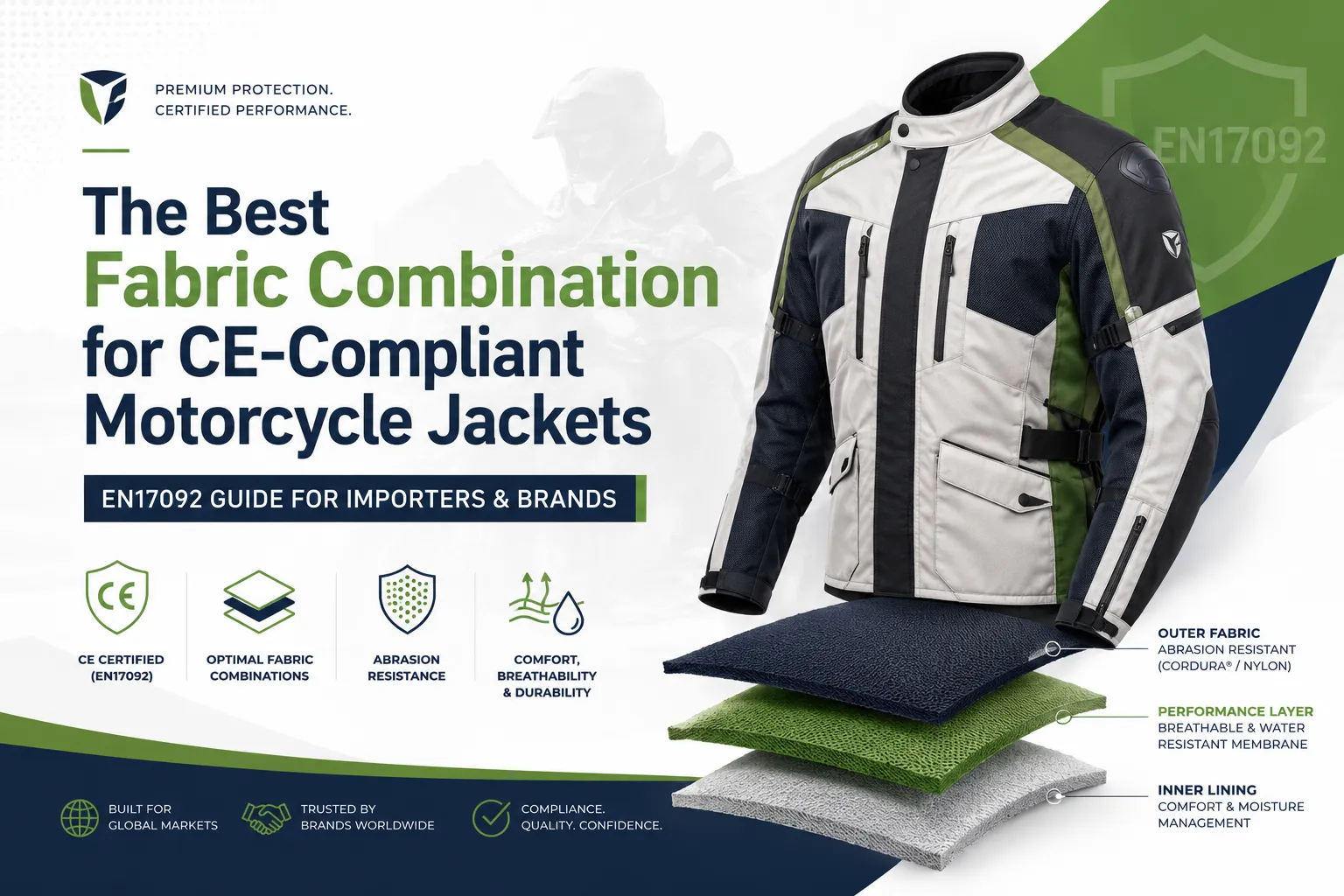
1. Introduction: Why Fabric Selection Decides CE Certification Success
For international brands developing motorcycle jackets for Europe, the UK, Australia, and other regulated markets, CE compliance is often misunderstood as a “testing stage” requirement.
In reality, CE approval starts much earlier. It starts from the fabric and construction decisions made at the development stage.
A motorcycle jacket is not a normal fashion product. It is a protective safety product designed to reduce injury during accidents. That is why under the EN17092 motorcycle apparel standard, every material used in the jacket contributes directly to safety performance.
If the fabric system is weak or incorrectly selected, the jacket may fail certification even before it reaches final testing. This leads to:
- repeated sampling
- higher development cost
- delayed market launch
- failed export shipments
At Sialkot Jackets Star, we help brands design CE-ready fabric systems from the beginning so that products are aligned with certification expectations before bulk production starts.
2. The Buyer Problem: Why Most Brands Struggle With CE Fabric Selection
Most importers, wholesalers, and private label brands entering motorcycle apparel face the same issue: they understand the design side, but not the technical safety requirements behind CE compliance.
This creates a major gap between what brands want and what certification actually demands.
Common challenges buyers face
| Problem Area | What Brands Usually Do | What Actually Happens |
| Fabric selection | Choose based on look or price | Jacket fails CE requirements |
| Supplier dependency | Trust supplier without technical clarity | No understanding of compliance limits |
| Product planning | Focus on style first | Redesign needed later |
| Cost control | Reduce material cost | Higher failure and rework cost |
| Certification | Treated as final step | Testing failure at late stage |
The core issue is simple: CE motorcycle jackets are engineered products, not fashion garments.
Without correct fabric planning, even a well-designed jacket will not pass certification.
3. Understanding EN17092 in Simple Buyer-Friendly Terms
The EN17092 standard is the European safety rulebook for motorcycle protective clothing. It defines how strong a jacket must be to protect a rider during real-life accidents like sliding on asphalt.
Instead of focusing on appearance, it measures real protection performance.
CE protection levels explained simply
| CE Level | Simple Meaning | Typical Use Case | Protection Strength |
| A | Basic protection | City riding, low speed | Low |
| AA | Balanced protection | Touring, daily riding | Medium |
| AAA | Maximum protection | High-speed riding | High |
Each level requires stronger fabric, stronger stitching, and better reinforcement.
So if a brand chooses the wrong fabric, it automatically limits the CE level they can achieve.
4. Motorcycle Jacket Fabric Requirements (Explained in Simple Language)
To pass CE expectations, a motorcycle jacket fabric must perform well in real accident conditions.
Instead of technical jargon, here is what it means in practical terms:
4.1 Abrasion Resistance (Sliding Protection)
This is how long the fabric survives when a rider slides on the road.
If abrasion resistance is low, the jacket can wear through quickly, exposing the rider to injury.
4.2 Tear Resistance (Ripping Strength)
This measures how hard it is to tear the fabric when force is applied suddenly.
If the fabric tears easily, the jacket loses protective structure during impact.
4.3 Structural Strength (Shape Stability)
The jacket must stay intact under pressure without losing shape or breaking apart at stress points like shoulders or elbows.
4.4 Real-World Requirement
A CE motorcycle jacket is not made from a single fabric type. It is a combination of materials that work together to provide protection, comfort, and durability.
5. Best Fabric Systems for CE-Compliant Motorcycle Jackets
Instead of choosing one material, CE jackets use fabric systems. Each system is designed for a specific riding condition and CE level.
5.1 Cordura Fabric System
Cordura is one of the most trusted materials in motorcycle jackets globally.
It is made from high-strength synthetic fibers designed to resist abrasion.
Cordura variants and usage
| Cordura Type | Strength Level | Flexibility | Best Use |
| 500D | Medium | High | Urban jackets |
| 600D | High | Medium | Touring jackets |
| 1000D | Very High | Lower | Adventure jackets |
Why brands choose Cordura
- Strong abrasion resistance
- Lightweight compared to leather
- Suitable for mass production
- Balanced cost and performance
Cordura is usually the base fabric for most CE-certified textile jackets.
5.2 Leather Fabric System
Leather is one of the strongest natural materials used in motorcycle jackets.
Types of leather used
| Leather Type | Quality Level | Protection | Market Position |
| Full-grain leather | Highest | Maximum | Premium export brands |
| Top-grain leather | High | Strong | Mid-premium segment |
| Corrected grain leather | Medium | Moderate | Cost-efficient production |
Why leather is used
- Naturally high abrasion resistance
- Long-lasting durability
- Premium appearance for retail markets
- Strong CE performance for higher categories
Leather jackets are often used in performance or premium fashion segments.
5.3 Softshell Fabric System
Softshell is commonly used in urban motorcycle jackets.
Characteristics
- Lightweight and flexible
- Comfortable for daily wear
- Wind and water resistance
- Easy movement for riders
Limitations
| Advantage | Limitation |
| Comfortable for city riding | Not suitable alone for high CE levels |
| Good flexibility | Needs reinforcement for AA/AAA |
Softshell is usually combined with stronger materials for CE compliance.
5.4 Multi-Layer Composite System
This is the most advanced system used in high-end CE motorcycle jackets.
It combines multiple protective layers:
| Layer | Function |
| Outer shell | Abrasion protection |
| Mid layer | Impact absorption |
| Inner lining | Comfort and breathability |
Why this system is used
- Highest CE compliance capability
- Suitable for AAA-level jackets
- Used in export-focused premium products
6. Recommended Fabric Combinations (Real Export Use Cases)
Different markets and price points require different combinations.
| Jacket Type | Fabric Combination | CE Target Level | Buyer Segment |
| Urban Riding Jacket | Softshell + reinforced polyester panels | A / AA | City riders |
| Touring Jacket | 600D Cordura + mesh lining | AA | Global retailers |
| Adventure Jacket | 1000D Cordura + reinforced zones | AA / AAA | Premium importers |
| Leather Biker Jacket | Full-grain leather + stretch panels | AA / AAA | High-end brands |
| Racing Style Jacket | Leather + Cordura + armor zones | AAA | Performance markets |
These combinations are widely used in export manufacturing because they balance compliance and cost efficiency.
7. Why Fabric Alone Is Not Enough for CE Approval
Many buyers assume that using strong fabric is enough for certification. This is not true.
Even the best fabric will fail CE tests if construction is weak.
Key construction requirements
- Armor must be correctly placed at impact zones
- Stitching must be reinforced in elbows and shoulders
- Double or triple stitching is required in stress areas
- Seam alignment must prevent tearing under pressure
- Panels must be structured to distribute force
Simple explanation
Fabric provides strength, but construction ensures that strength is used correctly during impact.
8. Common Mistakes Brands Make During Development
Most CE failures happen due to avoidable mistakes:
- Choosing fabric only based on cost
- Not aligning fabric with CE target level
- Ignoring stitching and construction requirements
- Skipping proper sampling stage
- Working with suppliers without technical CE knowledge
- Treating motorcycle jackets like fashion products
These mistakes usually result in rework, delays, or certification failure.
9. Manufacturing Approach at Sialkot Jackets Star
We follow a structured OEM process designed for export brands:
| Stage | What We Do |
| Requirement analysis | Understand CE target and market |
| Fabric selection | Choose correct material system |
| Sample development | Build CE-aligned prototypes |
| Testing alignment | Check construction and reinforcement |
| Bulk production | Ensure consistent output |
This approach helps brands reduce risk and improve approval success rate in export markets.
10. Cost Impact of Fabric Selection
Fabric choice directly affects production cost and market positioning.
| Fabric Type | Cost Level | CE Capability | Market Position |
| Softshell | Low | Low–Medium | Entry-level |
| Cordura | Medium | High | Mass export |
| Leather | High | High | Premium segment |
| Multi-layer system | Very High | Very High | Professional racing |
Important insight:
Saving cost on fabric often increases total project cost due to failure, rework, and delays.
11. Who This Guide Is Designed For
This information is most useful for:
- Motorcycle apparel importers
- Private label brands launching CE collections
- Wholesalers expanding product lines
- Retailers sourcing certified riding gear
- Startups entering safety apparel market
12. Final Summary
CE-certified motorcycle jackets are not built at the testing stage. They are engineered at the material selection stage.
Fabric determines protection level, but construction determines certification success.
Brands that understand this early can launch faster, reduce cost risk, and build stronger export products.
Sialkot Jackets Star supports brands in developing CE-ready motorcycle jackets designed for real-world riding conditions and international compliance standards.
FAQs: CE Motorcycle Jackets & Fabric Requirements (High Buyer Intent)
Cordura and leather are the most widely used because they provide high abrasion resistance needed for CE approval.
No. CE certification depends on fabric strength plus stitching, reinforcement, and full construction quality.
It is a European safety standard that defines how protective a motorcycle jacket must be during real riding accidents.
600D Cordura is commonly used for AA-level jackets because it balances protection, comfort, and cost.
Leather offers higher natural abrasion resistance, but both materials can achieve CE compliance depending on construction.
Most failures happen due to weak seams, poor reinforcement, or incorrect fabric selection for the CE level.
Yes, but usually only for lower protection levels unless reinforced with stronger materials.
AA provides balanced protection for normal riding, while AAA is designed for high-risk, high-speed riding conditions.
Stronger fabrics like leather and high-denier Cordura increase cost but improve compliance and market acceptance.
Yes, experienced OEM manufacturers guide brands in selecting fabrics, construction methods, and sampling for CE compliance.