

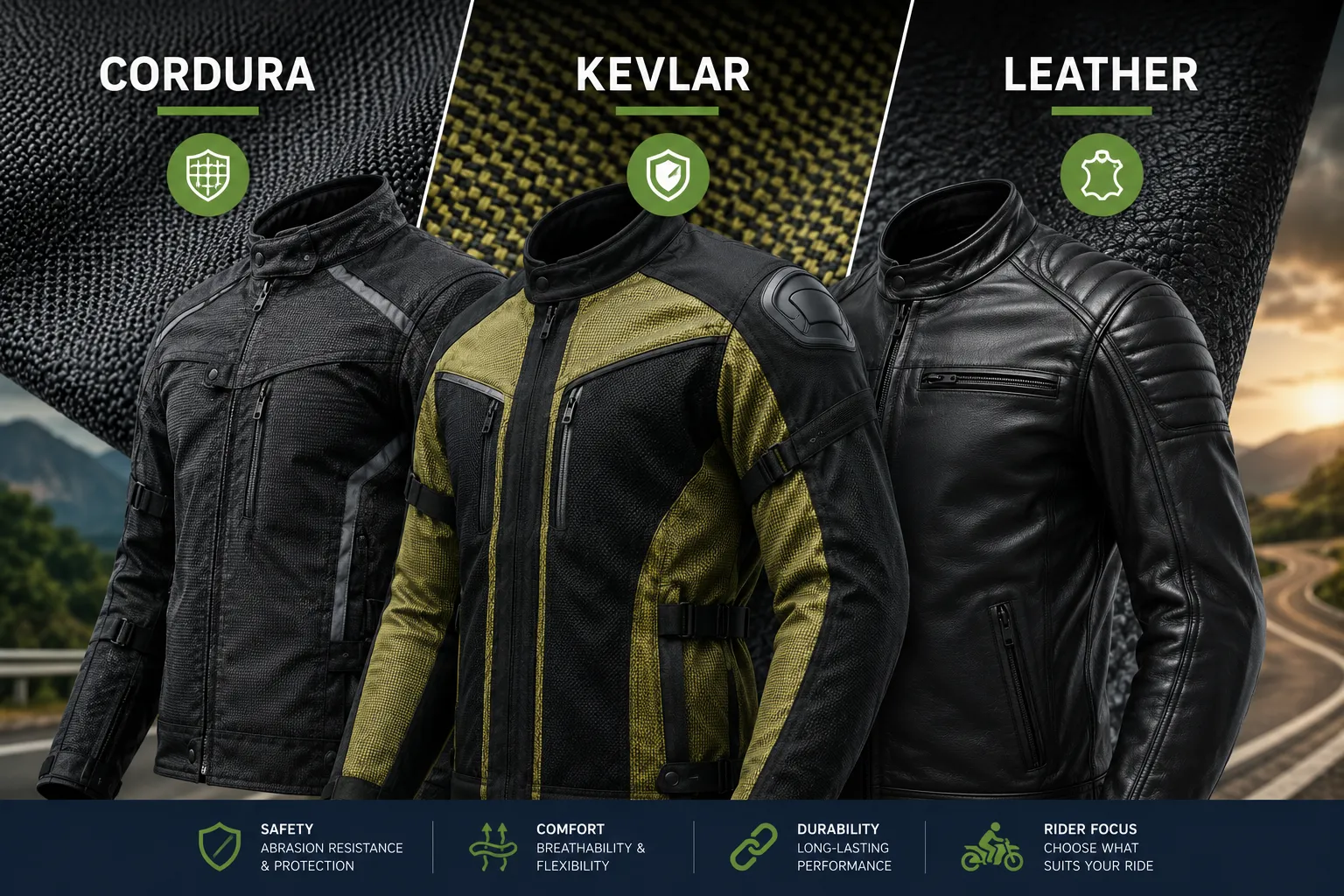
1. Introduction: Why This Decision Matters More Than Most Brands Realize
When brands start developing motorcycle jackets for export markets, one of the first and most confusing decisions is material selection.
Cordura, Kevlar, and leather all sound like “premium” options, but in reality, each one performs a completely different job in a product line. The right choice doesn’t just change how the jacket looks, it changes how it sells, what price it can carry, and which type of rider will actually buy it.
For OEM and private label brands, this decision directly impacts:
- Your unit cost per jacket
- Your retail positioning (budget, mid-range, premium)
- Your ability to meet safety expectations in export markets
- Your repeat order potential from distributors and wholesalers
This guide breaks everything down in simple terms so you can choose materials based on real market performance, not assumptions.
2. What Most Brands Struggle With (Before Product Development Starts)
Most importers and new brands face the same issue: they try to compare materials as if one is “better” than the other.
But in manufacturing reality, the better question is:
Which material fits my customer segment and pricing strategy?
For example:
- If you choose leather for a budget commuter jacket, your price becomes too high for mass buyers
- If you use only Cordura for a premium brand, your product may look under-positioned
- If you ignore Kevlar in safety-focused markets, your jackets may fail compliance expectations
So the goal is not choosing the strongest material, but choosing the right combination for your target market.
3. Motorcycle Jacket Materials Explained in Simple, Practical Terms
3.1 Cordura Fabric: The Workhorse for Scalable Production
Cordura is one of the most widely used materials in motorcycle jackets because it gives brands a practical balance between cost, durability, and production scalability.
Think of Cordura as the “reliable base material” for bulk production.
What it actually helps you achieve in business terms:
- Keeps production cost stable when scaling orders
- Works well for large retail chains and distributors
- Allows flexible design without increasing cost too much
- Performs well in everyday riding conditions
It is not about luxury. It is about consistency and volume.
Where Cordura performs best:
| Market Type | Why Cordura Works |
| Entry-level motorcycle gear | Affordable pricing for mass riders |
| Daily commuter jackets | Lightweight and comfortable |
| OEM bulk orders | Easy to scale production |
| Private label startups | Low risk, high flexibility |
Cordura is usually the starting point for brands that want volume-driven growth.
3.2 Kevlar: The Safety Reinforcement Layer, Not a Full Material
Kevlar is often misunderstood. It is not typically used as the outer shell of a jacket. Instead, it is used inside the jacket to strengthen specific impact zones.
In simple terms:
Cordura or other fabrics form the outer structure, and Kevlar is added underneath where extra protection is needed.
What Kevlar actually gives your product:
- Strong reinforcement in crash-prone areas
- Better tear resistance under stress
- Strong positioning for safety-focused marketing
- Compatibility with CE-certified jacket development
Kevlar becomes important when your brand wants to move into safety-led markets rather than just fashion riding gear.
Where Kevlar fits in real production:
| Use Case | Business Benefit |
| CE-certified jackets | Helps meet safety expectations |
| Touring gear | Extra durability for long rides |
| Mid-to-premium range | Justifies higher pricing |
| Export safety markets | Builds technical credibility |
Kevlar is not about appearance. It is about performance reinforcement where it matters most.
3.3 Leather: The Premium Identity Material
Leather is the most traditional motorcycle jacket material, and it still holds strong value in global markets.
But its role today is very clear: it is a positioning tool for premium brands.
In simple business terms: Leather sells identity, not just protection.
What leather gives your brand:
- Strong premium perception in international markets
- High-value retail pricing potential
- Long-lasting product lifecycle
- Strong visual appeal for lifestyle riders
However, leather also comes with trade-offs like higher cost and heavier weight, which makes it less suitable for mass-market scaling.
Where leather performs best:
| Market Type | Why Leather Works |
| Premium biker brands | Strong brand identity |
| Fashion motorcycle jackets | Style-led positioning |
| High-margin exports | Supports higher retail pricing |
| Boutique collections | Limited, high-value production |
Leather is not about volume. It is about brand value and premium positioning.
4. Simple Comparison: Cordura vs Kevlar vs Leather (From a Business View)
| Factor | Cordura | Kevlar | Leather |
| Main Role | Outer fabric for volume production | Reinforcement material | Premium outer material |
| Cost Efficiency | High | Medium | Low |
| Safety Contribution | Medium | High | High |
| Comfort Level | High | High (as lining) | Medium |
| Market Position | Mass market | Safety-focused | Premium |
| Scalability | Very high | High | Medium |
| Best Use | Bulk OEM production | Protection enhancement | Branding & premium lines |
This table is not about which is best. It is about which one matches your business model.
5. How Brands Should Choose Materials Based on Market Strategy
5.1 If your focus is high-volume sales
Cordura-based jackets are the most practical choice. They allow you to maintain competitive pricing while still offering solid durability for everyday riders.
This is the most common direction for:
- Importers working with retail chains
- Wholesalers targeting large distribution networks
- New private label brands entering the market
5.2 If your focus is safety and certification-driven markets
Kevlar becomes important when your goal is to build CE-focused jackets that meet strict European expectations.
This is ideal when:
- You are targeting safety-conscious riders
- You want CE-rated product lines
- Your buyers expect technical specifications
5.3 If your focus is premium branding
Leather is the right direction when your product is meant to carry lifestyle value and higher retail margins.
This works best when:
- You are building a fashion-forward motorcycle brand
- Your target market is premium retail segments
- You are not competing on price but on identity
6. Why Most Successful Brands Don’t Use Just One Material
In modern motorcycle jacket manufacturing, most strong brands use a combination approach.
Instead of choosing one material, they combine:
- Cordura for structure and cost control
- Kevlar for safety reinforcement
- Leather for premium visual panels or branding sections
This hybrid approach gives brands more control over:
- Pricing tiers
- Market segmentation
- Product diversity within one collection
- Retail positioning flexibility
In export markets, this is becoming the standard, not the exception.
7. What Actually Changes in Manufacturing When You Change Material
This is where many brands underestimate the impact.
Material choice affects:
- Minimum order quantity
- Production time
- Stitching complexity
- Cost per unit
- CE certification structure
- Final product weight and comfort
For example:
- Leather requires more skilled stitching and longer production time
- Kevlar integration adds additional layering steps
- Cordura allows faster and more scalable production cycles
So material selection is also a production planning decision, not just a design choice.
8. Mistakes Brands Usually Make (And How to Avoid Them)
Many issues in motorcycle jacket businesses come from wrong early decisions:
- Choosing leather for budget markets and losing price competitiveness
- Ignoring Kevlar in safety-driven product categories
- Using Cordura without reinforcement strategy for premium positioning
- Not planning CE requirements before sampling
- Mixing materials without clear market segmentation
Avoiding these mistakes is often what separates successful brands from inconsistent ones.
9. Understanding CE Ratings: A, AA, and AAA Motorcycle Jackets Explained
CE ratings are not just technical labels they directly influence whether your jackets can enter regulated export markets like Europe.
They define how much protection a jacket provides during real riding conditions.
A Rating (Entry Protection Level)
This is the basic certification level.
What it means in simple terms:
- Designed for casual and low-risk riding
- Lightweight construction
- Common in entry-level Cordura jackets
- Suitable for urban commuters
This is ideal when your goal is affordability and mass adoption.
AA Rating (Balanced Protection Standard)
This is the most commonly targeted level in export manufacturing.
What it delivers:
- Stronger abrasion resistance
- Balanced comfort and protection
- Usually achieved through Cordura + Kevlar combination
- Suitable for touring and daily riding use
Most mid-range brands position their products in this category.
AAA Rating (Maximum Protection Level)
This is the highest CE category available for motorcycle jackets.
What it represents:
- Maximum abrasion resistance standards
- Heavy reinforcement in impact zones
- Often includes leather, Kevlar, and multi-layer construction
- Designed for serious riders and premium safety markets
This category is highly relevant in Europe and premium export segments.
10. How We Support Brands in Choosing the Right Material Strategy
Instead of just manufacturing jackets, the real value comes from helping brands structure the right product line. That includes:
- Selecting materials based on target market positioning
- Developing Cordura, Kevlar, and leather combinations
- Building CE-rated motorcycle jacket samples before bulk production
- Ensuring consistency in export-quality manufacturing
- Supporting brands from concept to scalable production
The goal is simple: help you launch jackets that are commercially viable from day one, not just technically correct.
FAQs
They are not direct alternatives. Cordura is used for the outer shell, while Kevlar is used for reinforcement.
Yes, especially when combined with proper ventilation and protective armor.
Because leather creates a strong premium identity and supports higher retail pricing.
Not always, but it is important for safety-focused and CE-rated product lines.
Cordura performs better due to its lighter structure and airflow options.
Cordura is the most scalable and cost-efficient option.
Yes, especially in Europe where safety compliance is a key requirement.
Yes, hybrid construction is commonly used in modern OEM manufacturing.
Leather jackets generally allow higher retail margins in premium markets.
Most brands use a combination strategy rather than relying on a single material.
Conclusion: Material Selection Is a Market Strategy, Not Just Fabric Choice
Cordura, Kevlar, and leather are not competing materials, they are tools for building different types of motorcycle jacket businesses.
- Cordura supports scalable production
- Kevlar enhances safety positioning
- Leather builds premium brand identity
The strongest export brands use them strategically to match real market demand and create structured product lines.
For OEM and private label buyers, the real success comes from aligning material choice with customer expectations, pricing strategy, and long-term brand positioning.
At Sialkot Jackets Star, we support brands in building exactly that kind of structured, export-ready motorcycle jacket collections. Contact us now if you are planning your gear.