
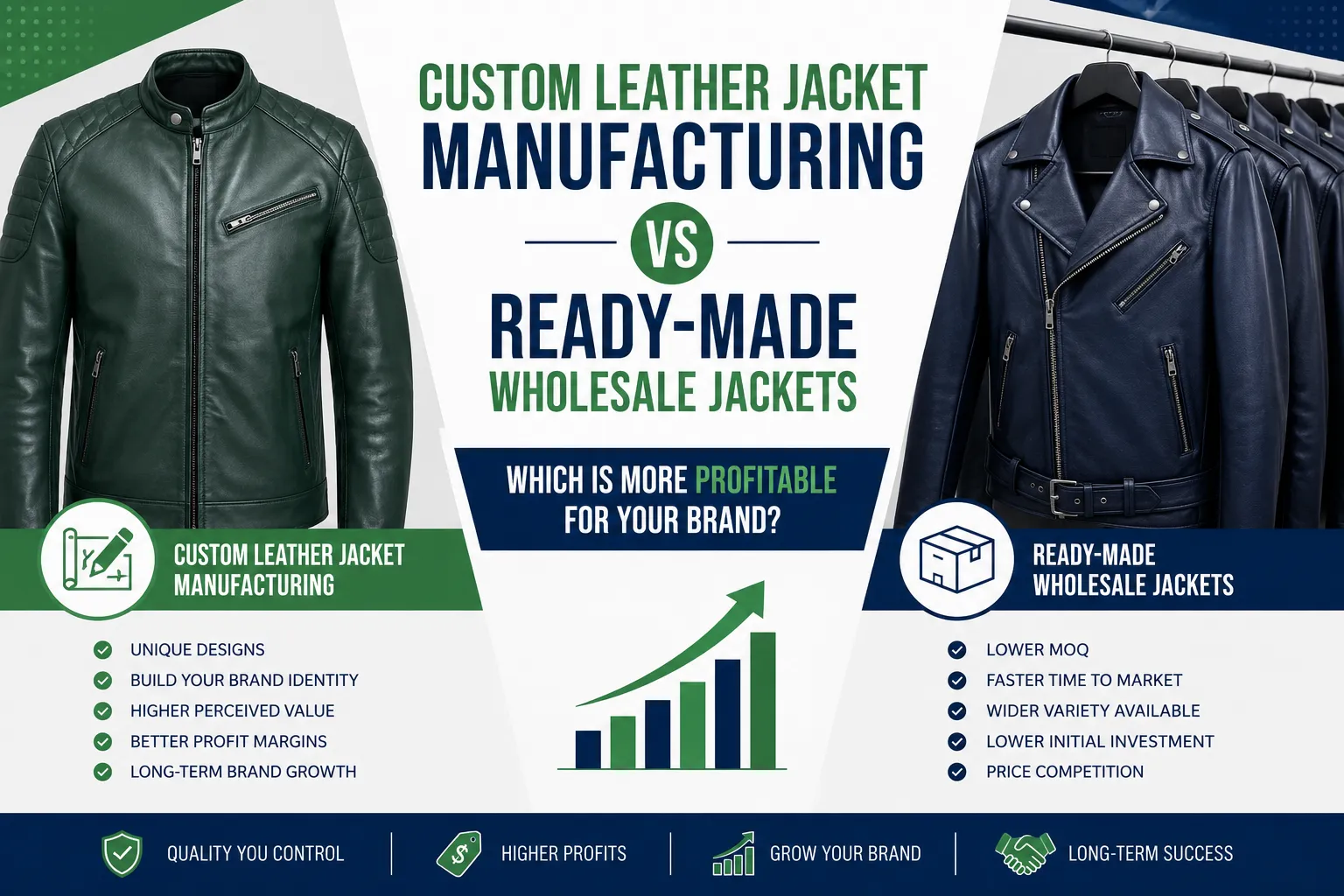
f you’re planning to add leather jackets to your product line, you’ve likely narrowed your sourcing options to two choices: buying ready-made wholesale jackets or investing in custom leather jacket manufacturing.
At first glance, the decision seems simple.
Ready-made wholesale jackets usually cost less upfront, require little product development, and allow you to launch your collection much faster. On paper, it appears to be the more profitable option.
However, this is exactly where many brands make a costly mistake.
They evaluate profitability based on the price they pay the manufacturer rather than the profit they generate after selling the product.
These are two completely different calculations.
As a buyer, your goal shouldn’t be to purchase the cheapest leather jacket. Your goal should be to build a product line that generates healthy margins, attracts repeat customers, and strengthens your brand over time.
That’s why asking “Which option is cheaper?” isn’t the right question.
Instead, you should ask yourself:
- Which sourcing model gives your brand a competitive advantage?
- Which option allows you to maintain better profit margins?
- Which one helps you build customer loyalty instead of competing on discounts?
- Which sourcing strategy will still benefit your business three years from now?
The answers to these questions will have a much bigger impact on your profitability than a difference of a few dollars in manufacturing cost.
As an OEM leather jacket manufacturer, we’ve worked with startups launching their first collection, established retailers expanding their product range, and private-label brands building exclusive collections for international markets.
One thing has remained consistent across all of them.
The brands that make sourcing decisions based only on cost often struggle to grow. The brands that evaluate sourcing as a long-term business strategy usually build stronger customer loyalty and healthier profit margins.
This doesn’t mean custom leather jacket manufacturing is always the better option.
Likewise, it doesn’t mean ready-made wholesale jackets are the wrong choice.
Both sourcing models can be profitable when they’re aligned with your business goals.
The key is understanding what you’re actually investing in before you place your order.
In this guide, you’ll learn the real differences between both sourcing models, the mistakes many brands make before placing bulk orders, and how to choose the option that supports your business today without limiting your growth tomorrow.
Mistake #1: Don’t Let a Lower Purchase Price Decide Your Entire Business Strategy
One of the biggest mistakes buyers make is believing that a lower manufacturing cost automatically leads to higher profits.
It sounds logical.
If Supplier A offers a leather jacket for $40 and Supplier B quotes $48, choosing the cheaper supplier appears to save money immediately.
But manufacturing cost tells only a small part of the story.
Your actual profitability depends on what happens after the jackets arrive in your warehouse.
Ask yourself these questions before comparing quotations:
| Instead of Asking… | Ask Yourself… |
| Which supplier is cheaper? | Which product will generate better profit margins? |
| Which quotation saves me money today? | Which sourcing model will help my brand grow over the next few years? |
| Which manufacturer offers the lowest price? | Which option gives me better pricing power in the market? |
| How much will I spend? | How much value can I create for my customers? |
This small shift in thinking can completely change your sourcing decision.
For example, imagine you purchase a ready-made leather jacket that is already being sold by dozens of retailers.
Your competitors have access to the same design.
The materials are similar.
The features are almost identical.
Now think about what happens when customers compare products online.
If every jacket looks the same, what usually becomes the deciding factor?
Price.
Soon, you’re lowering your prices to stay competitive.
Another retailer offers an additional discount.
Someone else includes free shipping.
Before long, you’re competing in a race where everyone is trying to earn less just to win the sale.
That’s not a manufacturing problem.
It’s a product differentiation problem.
Now consider a different scenario.
Instead of purchasing an existing design, you develop a leather jacket specifically for your brand.
The design, fit, branding, hardware, lining, and overall appearance are unique to your business.
Customers can’t simply search for the exact same product elsewhere.
Instead of comparing your jacket with ten identical alternatives, they’re evaluating your brand and the value your product offers.
That gives you something every growing business wants greater pricing power.
The table below highlights why manufacturing cost alone should never be the deciding factor.
| Comparing Only Manufacturing Cost | Evaluating Overall Profitability |
| Lower purchase price | Higher selling price potential |
| Immediate savings | Long-term profit margins |
| Short-term thinking | Sustainable business growth |
| Product cost | Brand value |
| Unit price | Customer loyalty |
| Cheap inventory | Competitive advantage |
This doesn’t mean you should ignore manufacturing costs.
Every successful buyer negotiates pricing and looks for the best possible value.
However, experienced brands understand that profitability isn’t created inside the factory alone.
It’s created when your product gives customers a reason to choose your brand over someone else’s.
That’s why many successful private-label brands are willing to invest slightly more in product development if it helps them create something competitors can’t easily copy.
Before Comparing Prices, Understand What You’re Actually Buying
Many buyers compare ready-made wholesale jackets and custom leather jacket manufacturing as though they’re simply two different purchasing options.
In reality, you’re choosing between two completely different business models.
One focuses on buying products that already exist.
The other focuses on creating products that represent your brand.
Understanding this difference is essential because it affects much more than manufacturing costs.
It influences your brand identity, pricing flexibility, customer perception, and long-term profitability.
Before deciding which option is more profitable, let’s first understand what each sourcing model actually offers.
Understanding the Two Business Models
Now that we’ve established why manufacturing cost alone doesn’t determine profitability, let’s look at what you’re actually investing in with each sourcing model.
While both options help you stock leather jackets, they support very different business strategies.
Ready-Made Wholesale Leather Jackets
Ready-made wholesale jackets are pre-designed products that are manufactured before you place your order. You’re selecting from an existing collection rather than creating your own.
This model is often suitable if you want to test a market quickly or expand your inventory without spending time on product development.
Some of the key advantages include:
- Faster time to market.
- Lower upfront investment.
- No design or pattern development.
- Simpler ordering process.
- Ideal for testing demand.
However, it’s important to understand the trade-offs.
The same jackets may also be available to other retailers, wholesalers, or online sellers. As a result, it’s difficult to create a unique identity around products that customers can purchase elsewhere.
Custom Leather Jacket Manufacturing
Custom manufacturing starts with your business requirements instead of an existing product catalogue.
Rather than selecting a finished jacket, you develop one that reflects your brand’s vision.
Depending on your requirements, you can customize:
- Leather type and finish.
- Jacket pattern and fit.
- Hardware and zippers.
- Stitching details.
- Lining materials.
- Labels and branding.
- Embroidery.
- Packaging.
- Hangtags.
- Private-label elements.
Instead of selling a product that belongs to the market, you’re building a product that belongs to your brand.
The process requires more planning, including sampling, approvals, and production scheduling, but it also gives you greater control over quality, branding, and product positioning.
| Comparison Factor | Ready-Made Wholesale | Custom Manufacturing |
| Product Design | Existing supplier designs | Designed according to your requirements |
| Product Exclusivity | Shared by multiple buyers | Exclusive to your brand |
| Branding Options | Limited | Complete private-label branding |
| Product Development | Not required | Required before production |
| Time to Market | Faster | Longer due to sampling |
| Brand Building | Limited | Strong long-term potential |
| Pricing Flexibility | Lower | Higher through product differentiation |
Neither option is universally better. The right choice depends on what you want your business to achieve.
Mistake #2: Selling the Same Jackets Everyone Else Is Selling
Many businesses don’t realize they’re creating a pricing problem before they even make their first sale.
When multiple retailers offer identical jackets, customers have very little reason to choose one seller over another.
They compare:
- Price.
- Delivery time.
- Discounts.
- Shipping costs.
Your product is no longer the competitive advantage.
Your price is.
This is one of the biggest reasons many businesses struggle to improve their profit margins despite finding low manufacturing costs.
Custom manufacturing changes that equation.
Instead of asking, “Who sells this jacket for less?” customers are asking, “Where can I buy this jacket?”
That’s a completely different buying journey.
Unique products allow you to compete on value instead of price.
They also make your marketing more effective because you’re promoting exclusive products rather than products available from dozens of suppliers.
Where Do Most Brands Actually Make, or Lose Their Profit?
Many buyers assume profit is determined at the factory.
In reality, profit is determined throughout the entire customer journey.
Consider the following comparison.
| Profit Driver | Ready-Made Wholesale | Custom Manufacturing |
| Ability to charge premium prices | Limited | Strong |
| Product differentiation | Low | High |
| Customer loyalty | Moderate | Higher |
| Repeat purchases | Product dependent | Brand dependent |
| Price competition | High | Lower |
| Long-term margins | Often decrease | Often improve |
Businesses that compete only on price usually experience shrinking margins over time.
Businesses that offer exclusive products often enjoy better pricing power because customers aren’t comparing identical products across multiple retailers.
This doesn’t happen overnight.
It happens through consistent branding and product differentiation.
The Hidden Costs Most Brands Don’t Calculate Until It’s Too Late
When comparing quotations, most buyers calculate visible costs.
These include:
- Manufacturing.
- Shipping.
- Duties.
- Warehousing.
However, some of the biggest costs never appear on a supplier’s quotation.
They appear later.
Examples include:
| Hidden Cost | Business Impact |
| Constant discounting | Reduced profit margins |
| Selling identical products | Increased competition |
| Weak brand recognition | Lower customer loyalty |
| Limited customization | Difficult to stand out |
| Dependence on supplier inventory | Less flexibility |
| Frequent product comparison | Lower pricing power |
These hidden costs often reduce profitability far more than paying a few dollars extra for a custom-developed product.
How Do You Know Which Option Is Right for Your Business?
The answer depends on where your business is today.
Ready-made wholesale jackets may be the better choice if you:
- Are launching a new business.
- Want to test market demand.
- Need inventory quickly.
- Have a limited product development budget.
Custom leather jacket manufacturing may be the better investment if you:
- Want to build a recognizable brand.
- Plan to scale your business.
- Want exclusive products.
- Need complete private-label branding.
- Want healthier long-term margins.
- Intend to reduce direct price competition.
There’s no single answer that fits every business.
The right sourcing model is the one that supports your growth strategy rather than simply reducing today’s costs.
Mistake #3: Waiting Too Long to Build Your Own Brand
Many businesses spend years selling products that customers remember but never associate with their brand.
The jackets may sell well.
The marketing campaigns may perform well.
But because the products aren’t unique, customers often remember the product rather than the company that sold it.
Over time, this becomes a growth challenge.
Brands with exclusive products usually build stronger recognition because customers connect the product with the business behind it.
That recognition creates:
- Better customer retention.
- Stronger word-of-mouth marketing.
- Greater pricing flexibility.
- More repeat orders.
- Higher perceived value.
If building a long-term brand is one of your goals, custom manufacturing deserves serious consideration.
Before You Choose a Manufacturer, Ask These Questions
Regardless of which sourcing model you choose, don’t make your decision based only on price.
Ask potential manufacturing partners questions such as:
- Can you manufacture according to my specifications?
- How do you maintain quality consistency across bulk production?
- What does your sampling process look like?
- Can you support private-label branding?
- How do you handle production updates and communication?
- What quality inspections are carried out before shipment?
- Can your production capacity support my business as it grows?
A reliable manufacturing partner should be able to answer these questions clearly and confidently.
Transparent communication before production usually reflects a well-managed production process.
Frequently Asked Questions
It depends on your business model. Ready-made wholesale jackets can generate quick sales with lower upfront investment, making them suitable for testing the market. However, businesses focused on building a recognizable brand often find that custom manufacturing offers stronger long-term profitability through product differentiation, better pricing power, and improved customer loyalty.
Yes. OEM manufacturers can produce jackets according to your specifications while incorporating your labels, branding, packaging, and design requirements. This allows you to build a product line that reflects your brand rather than selling generic products available to multiple retailers.
For many startups, ready-made wholesale jackets provide a practical way to enter the market with lower investment and faster turnaround. Once demand becomes consistent and the brand begins to grow, many businesses transition to custom manufacturing to improve product exclusivity and profitability.
Established brands often focus on creating products that competitors can’t easily replicate. Custom manufacturing gives them greater control over design, branding, product quality, and customer experience while reducing direct price competition.
Final Thoughts
There’s no universal winner in the debate between custom leather jacket manufacturing and ready-made wholesale jackets.
Both sourcing models have their place.
If your objective is to enter the market quickly, validate demand, or operate with a limited budget, ready-made wholesale jackets can be a practical starting point.
However, if you’re building a long-term brand, aiming for healthier profit margins, and looking to offer products your competitors can’t easily copy, custom leather jacket manufacturing often becomes the more strategic investment.
Before placing your next bulk order, don’t evaluate your options based solely on manufacturing cost.
Consider how each sourcing model will influence your pricing power, customer loyalty, market positioning, and long-term business growth.
The most profitable sourcing decision isn’t always the one that costs the least today it’s the one that creates the greatest value for your business in the years ahead.