

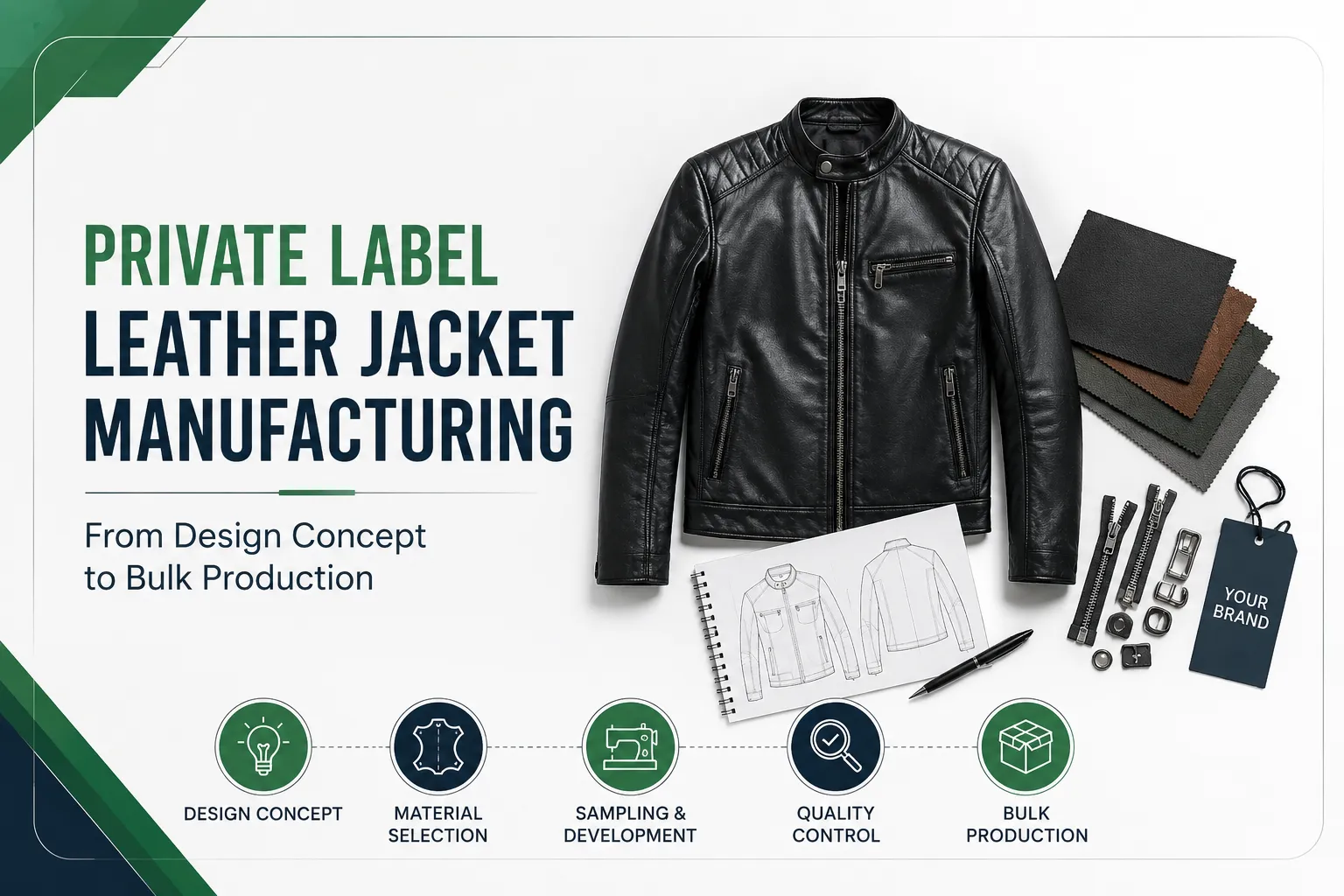
Launching a private label leather jacket brand is an exciting opportunity, but it’s also a process where the decisions you make before production can determine whether your collection becomes a long-term success or an expensive learning experience.
Many brands believe the journey begins when they find a manufacturer.
It doesn’t.
It begins much earlier with your planning.
As an OEM and private label manufacturer, we’ve seen businesses approach manufacturing with nothing more than a few reference images, expecting the factory to handle everything else. While experienced manufacturers can certainly guide you, relying entirely on them without a clear direction often leads to unnecessary revisions, production delays, and additional costs.
On the other hand, brands that enter the process with well-defined objectives usually experience smoother product development, faster approvals, and better production outcomes.
That’s because private label manufacturing isn’t simply about producing leather jackets.
It’s about transforming your business idea into a product your customers recognize, trust, and choose over competing brands.
Whether you’re launching your first leather jacket collection or expanding an existing product range, understanding each stage of the manufacturing process will help you make informed decisions and avoid costly mistakes.
In this guide, you’ll learn how your idea moves from an initial concept to bulk production, what information manufacturers need before development begins, and how thoughtful planning can save both time and money throughout the production process.
Before You Contact a Manufacturer, Prepare These Essentials
One of the biggest misconceptions about private label manufacturing is that you need a completed design before speaking with a manufacturer.
You don’t.
What you do need is enough information to help your manufacturing partner understand your vision.
The more clearly you communicate your goals, the easier it becomes to recommend suitable materials, estimate production costs, develop accurate samples, and plan bulk manufacturing.
Before reaching out to a manufacturer, prepare the following information.
| What You Should Prepare | Why It Matters |
| Product idea or collection concept | Helps the manufacturer understand your vision and recommend the right production approach. |
| Reference images or sketches | Reduces misunderstanding during product development. |
| Target market | Influences leather selection, construction, and product positioning. |
| Estimated order quantity | Helps determine production planning and material sourcing. |
| Target retail or wholesale price | Allows the manufacturer to recommend materials that align with your pricing strategy. |
| Branding requirements | Ensures labels, logos, packaging, and trims are planned from the beginning. |
| Preferred launch timeline | Supports realistic production scheduling and delivery planning. |
You don’t need to have every detail finalized.
In fact, many successful brands begin with only a clear concept and a vision for the type of customer they want to serve.
An experienced private label manufacturer should be able to guide you through the remaining stages while helping you refine your product before production begins.
What matters most is approaching the conversation with clear business objectives rather than simply asking for the lowest possible price.
Step 1: Turn Your Design Idea into a Production-Ready Concept
Many brands believe manufacturing starts with cutting leather.
In reality, manufacturing starts with making decisions.
Before any materials are ordered or production schedules are created, your idea needs to become a product that can actually be manufactured consistently.
This is one of the most important stages in private label leather jacket manufacturing because every decision made here affects quality, production efficiency, and overall profitability.
At this stage, your manufacturer works with you to understand exactly what you want to create.
Depending on your project, this may include reviewing:
- Design sketches
- Reference garments
- Inspiration images
- Technical drawings
- Existing samples
- Brand guidelines
- Target pricing
- Functional requirements
Many buyers ask an important question at this point:
“Do I need a professional tech pack before contacting a manufacturer?”
The answer depends on your experience.
If you already have a detailed tech pack, it can certainly speed up communication.
However, many startups and growing brands don’t have one.
That’s completely normal.
A knowledgeable manufacturer should be able to work from clear reference materials and help convert your ideas into production-ready specifications.
The important thing is that both sides have a shared understanding of the final product before sampling begins.
Don’t Make the Mistake of Assuming a Picture Tells the Whole Story
One of the most common mistakes brands make is sending a single image and expecting it to contain all the information needed for production.
Unfortunately, photographs don’t reveal critical manufacturing details.
For example, an image cannot accurately communicate:
- Leather thickness.
- Stitch density.
- Internal construction.
- Lining material.
- Reinforcement areas.
- Hardware specifications.
- Fit preferences.
- Sleeve measurements.
- Pocket construction.
Without discussing these details, manufacturers are forced to make assumptions.
And assumptions often lead to revisions that increase both development time and cost.
Instead, treat reference images as the starting point for a conversation not the final production instructions.
The more information you provide during this stage, the fewer changes you’ll need later in the process.
Think Beyond Design, Think About Your Customer
Another mistake many brands make is focusing entirely on how the jacket looks.
Appearance is important, but it’s only one part of creating a successful product.
Before approving any design, ask yourself questions such as:
- Who will be wearing this jacket?
- Is it designed for fashion, motorcycle riding, or everyday wear?
- What climate is it intended for?
- Should it prioritize lightweight comfort or heavy-duty durability?
- What retail price are you targeting?
- Which product features will justify that price?
These questions help your manufacturer recommend materials and construction methods that align with your business goals rather than simply recreating a design.
The table below shows how different design decisions influence the final product.
| Design Decision | Why It Matters |
| Leather selection | Affects durability, appearance, and product positioning. |
| Jacket fit | Influences customer comfort and sizing consistency. |
| Hardware selection | Impacts functionality, durability, and perceived quality. |
| Lining choice | Determines comfort and seasonal suitability. |
| Branding elements | Strengthens brand recognition and customer recall. |
| Construction details | Affect long-term product performance and manufacturing consistency. |
By the end of this stage, your objective shouldn’t simply be to have an attractive design.
Your objective should be to have a product that can be manufactured consistently, meets your quality expectations, supports your target price, and reflects your brand identity.
Once your concept has been clearly defined, the next step is selecting the right leather, hardware, and materials because even the best design can fall short if the materials don’t match your customers’ expectations or your market positioning.
Step 2: Choose Materials That Match Your Brand Positioning
Once your design concept has been finalized, the next step is selecting the materials that will bring your product to life.
This is where many brands make another costly mistake.
They choose materials based primarily on cost instead of the expectations of their target customers.
Remember, your customers won’t judge your jacket by the price you paid to manufacture it. They’ll judge it by how it looks, feels, fits, and performs after repeated use.
Every material you choose contributes to that experience.
From the type of leather and lining to the zippers, buttons, and labels, every component influences your product’s perceived value.
Instead of asking, “What’s the cheapest option?”, ask yourself:
“Which materials best support the market I’m trying to serve?”
For example, a premium fashion brand and a motorcycle apparel brand may both manufacture leather jackets, but their material requirements will be completely different.
| Material Decision | How It Impacts Your Product |
| Leather type | Determines appearance, durability, and product positioning. |
| Lining material | Affects comfort, breathability, and seasonal use. |
| Hardware | Influences durability and premium perception. |
| Stitching quality | Impacts product strength and longevity. |
| Labels & branding | Reinforces your brand identity. |
| Packaging | Creates a stronger first impression and customer experience. |
Choosing the right combination of materials helps you create a product that aligns with both your pricing strategy and your customers’ expectations.
Mistake #1: Approving Bulk Production Without Sampling
If there’s one stage you should never rush, it’s sampling.
Some buyers view samples as an unnecessary expense or delay.
In reality, sampling is one of the most valuable investments in the entire manufacturing process.
A sample allows you to evaluate your product before committing to bulk production.
It’s your opportunity to confirm that every important detail meets your expectations.
During sample approval, you should evaluate:
- Overall fit.
- Leather quality.
- Stitching consistency.
- Hardware functionality.
- Branding placement.
- Measurements.
- Comfort.
- Overall finish.
If something doesn’t meet your expectations, it’s far easier and far less expensive to make adjustments during sampling than after hundreds of jackets have already been produced.
Think of the sample as your final quality checkpoint before production begins.
Step 3: Bulk Production Begins
Once the sample has been approved, bulk production can begin with confidence.
At this stage, your manufacturer follows the approved specifications developed during product development and sampling.
Although the production process includes multiple technical operations, your focus as a buyer should be on consistency.
Every jacket should match the approved sample in terms of:
- Materials.
- Measurements.
- Construction.
- Branding.
- Overall finish.
Maintaining consistency across hundreds or even thousands of jackets requires structured production planning, experienced craftsmanship, and continuous quality monitoring.
This is one of the reasons choosing an experienced private label manufacturer is so important.
A reliable manufacturing partner doesn’t simply produce jackets they produce them consistently.
How Quality Control Protects Your Investment
Many buyers think quality control happens only after production has finished.
Professional manufacturers know that quality should be monitored throughout the entire manufacturing process.
Multiple inspections help identify potential issues before they become larger production problems.
A structured quality control process typically includes:
| Inspection Stage | Purpose |
| Raw material inspection | Verify leather, hardware, and other materials before production starts. |
| In-line inspection | Monitor stitching, construction, and workmanship during production. |
| Final inspection | Confirm measurements, branding, finishing, and overall quality. |
| Pre-shipment inspection | Ensure products are packed correctly before export. |
These inspections help reduce the risk of inconsistencies, minimize defects, and ensure your customers receive products that meet the quality standards your brand promises.
Mistake #2: Choosing a Manufacturer Based Only on Price
It’s natural to compare quotations when sourcing leather jackets.
However, choosing a manufacturer based solely on the lowest price often becomes expensive in other ways.
A lower quotation may not include the same level of quality control, communication, production planning, or after-sales support.
Before making your decision, consider the complete value a manufacturer brings to your business.
Ask yourself:
- Do they understand private label manufacturing?
- Can they provide consistent quality across every production run?
- Are they transparent throughout the manufacturing process?
- Can they support your business as your order volumes grow?
- Do they communicate clearly when changes or challenges arise?
The right manufacturing partner should help you reduce risk not create uncertainty.
What Determines Your Production Timeline?
One question nearly every buyer asks is:
“How long will production take?”
The answer depends on several factors, including product complexity, material availability, order quantity, and production scheduling.
Rather than focusing only on the final delivery date, it’s helpful to understand the different stages involved.
| Production Stage | What Happens |
| Product development | Design discussions and project planning. |
| Sample development | Prototype creation and revisions. |
| Material sourcing | Procurement of leather, hardware, and trims. |
| Bulk production | Cutting, stitching, assembly, and branding. |
| Quality inspections | In-process and final quality checks. |
| Packing & shipment | Export preparation and dispatch. |
Planning your production schedule early gives both you and your manufacturer enough time to complete every stage without compromising quality.
Questions You Should Ask Before Choosing a Private Label Manufacturer
Before committing to a manufacturing partner, don’t hesitate to ask detailed questions.
A reliable manufacturer should be willing to explain their process and help you make informed decisions.
Some important questions include:
- Can you manufacture according to my design specifications?
- What is your sample development process?
- How do you ensure quality consistency during bulk production?
- Can you customize labels, packaging, and branding?
- How do you communicate production updates?
- Can you support larger production volumes as my business grows?
- What happens if adjustments are required after sampling?
The answers will tell you far more about a manufacturer’s capabilities than the quotation alone.
Frequently Asked Questions
Private label leather jacket manufacturing is a production model where a manufacturer produces jackets according to your brand’s requirements rather than selling existing designs. This allows you to customize elements such as materials, fit, branding, labels, packaging, and product details so the finished jackets represent your business instead of the manufacturer’s catalogue.
No. While a detailed tech pack can make communication more efficient, many startups and growing brands begin with reference images, sketches, or sample garments. An experienced OEM manufacturer should be able to help convert your concept into production-ready specifications before sampling begins.
Yes. Private label manufacturing is designed to help you build your own brand. Depending on your project requirements, you can typically customize woven labels, printed neck labels, hangtags, care labels, packaging, and other branding elements to create a consistent brand identity.
Sample approval is one of the most critical stages of the manufacturing process. It allows you to evaluate fit, materials, workmanship, branding, and construction before full-scale production begins. Approving a well-developed sample significantly reduces the risk of costly corrections during bulk manufacturing.
Look beyond pricing. Evaluate the manufacturer’s experience, communication, sampling process, quality control system, production capacity, and ability to support your long-term growth. A reliable manufacturing partner should help you develop better products, maintain consistent quality, and build a stronger brand.
Final Thoughts
Building a successful private label leather jacket brand isn’t simply about finding a factory to manufacture your products.
It’s about choosing a manufacturing partner that understands your vision, helps you make informed decisions, and maintains consistent quality from the first sample to the final shipment.
Every stage of the process from preparing your concept and selecting the right materials to approving samples and monitoring quality control plays a role in the success of your collection.
The more carefully you plan these stages, the more confidently you can invest in bulk production and build products that strengthen your brand in a competitive market.
Whether you’re launching your first collection or expanding an established product line, taking a strategic approach to private label manufacturing will help you reduce production risks, improve product consistency, and create leather jackets your customers will continue to trust and buy.