

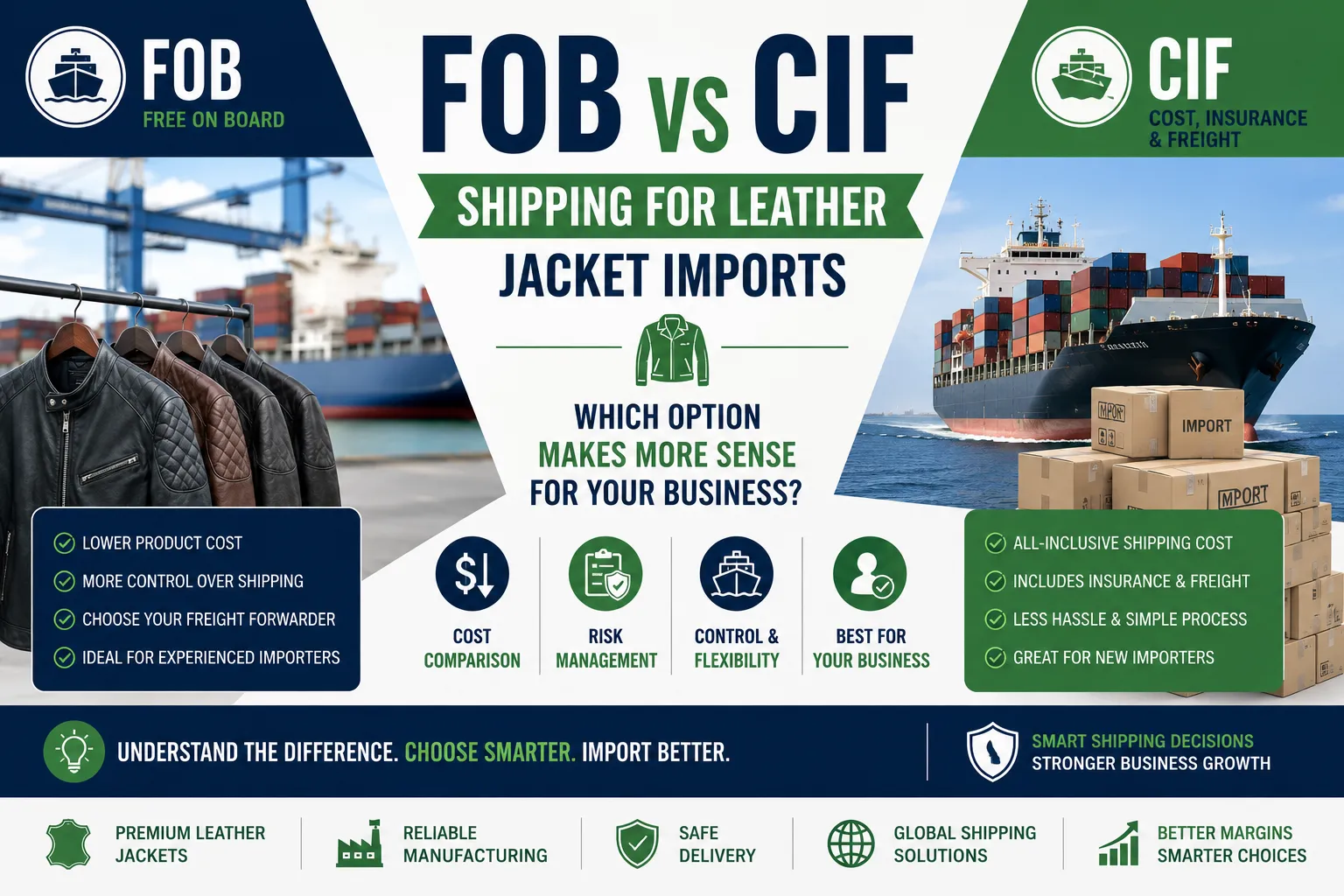
If you’ve started discussing a bulk leather jacket order with a manufacturer, you’ve probably reached the point where they ask:
“Would you like to ship your order under FOB or CIF terms?”
For many buyers, this question comes much later in the sourcing process. By then, the jacket designs have been finalized, samples are approved, production timelines are agreed upon, and everyone is focused on getting the order manufactured.
Then suddenly, you’re expected to choose between two shipping terms that may not be part of your everyday business vocabulary.
We’ve noticed that many first-time importers immediately ask one question:
“Which option is cheaper?”
It’s a reasonable question but it’s not the right one.
A better question is:
Which shipping option gives my business the right balance of cost, control, and convenience?
That’s because FOB and CIF don’t simply change the shipping quotation. They change who is responsible for different stages of your shipment, who manages the logistics, and how much control you have once your jackets leave the factory.
Over the years, we’ve worked with buyers ranging from newly launched private label brands to established distributors importing multiple containers every year.
One thing we’ve learned is that there isn’t a “best” shipping term for everyone.
The right choice depends on your experience, your logistics network, and how involved you want to be in managing international freight.
This guide isn’t written to convince you that FOB is better than CIF or vice versa.
Instead, we’ll help you understand how each shipping method works in real business situations so you can choose the one that supports your importing strategy rather than complicating it.
Before Comparing FOB and CIF, Ask Yourself One Simple Question
Before you compare shipping terms, take a step back and ask yourself:
How much of the shipping process do I actually want to manage?
Surprisingly, this is the question many buyers never ask.
Some businesses have long-standing relationships with freight forwarders. They negotiate freight rates every month, consolidate shipments from different suppliers, and already have established customs brokers in their country.
For these companies, managing international shipping is simply part of their daily operations.
Other businesses are in a completely different position.
Perhaps you’re launching your first leather jacket collection.
Maybe you’re expanding into a new product category.
Or you’ve found a manufacturer you trust, but you don’t yet have a logistics partner to handle international freight.
Neither situation is better than the other.
They simply require different shipping solutions.
That’s why choosing between FOB and CIF shouldn’t be based solely on price.
It should be based on the level of responsibility your business is prepared to handle.
| Before Choosing a Shipping Term, Consider This | Why It Matters |
| Do you already work with a freight forwarder? | If yes, you’ll probably want more control over shipping arrangements. |
| Have you imported products before? | Experienced importers often manage freight differently from first-time buyers. |
| Do you understand your country’s customs process? | Knowing the import procedure helps determine how much external support you’ll need. |
| Are you looking for convenience or greater control? | Your answer often points naturally toward the shipping option that suits you best. |
When buyers answer these questions honestly, the decision becomes much easier.
In Our Experience, Shipping Is Rarely the Biggest Challenge
Many new importers spend weeks comparing shipping quotations while overlooking something much more important.
The manufacturer.
We’ve seen buyers save a few hundred dollars on freight, only to lose far more because production wasn’t managed properly, export documents contained errors, or communication broke down before shipment.
International shipping follows established procedures.
An experienced exporter understands those procedures.
The bigger challenge is finding a manufacturing partner that can deliver consistent quality, prepare accurate documentation, coordinate production efficiently, and communicate clearly from the day your order is confirmed until it reaches the port.
At Sialkot Jackets Star, we see shipping as the final stage of a much larger process.
By the time your order is ready to leave Pakistan, the most important work should already be complete.
Your jackets should have passed quality inspections, your export documents should be prepared correctly, and you should already know exactly what to expect during shipment.
That’s why we encourage buyers to look beyond freight costs and shipping terms.
The exporter behind your shipment often has a greater impact on your importing experience than the shipping method itself.
In the next section, we’ll break down FOB shipping in practical terms, explain how it works in real import scenarios, who it’s best suited for, and why many experienced leather jacket importers continue to choose it for their international orders.
What Does FOB Shipping Really Mean for Your Business?
One question we hear quite often from buyers is:
“If I choose FOB, what exactly will I be responsible for?”
It’s a fair question because many articles simply define FOB in one sentence without explaining what it means in a real sourcing project.
Let’s look at it from a practical perspective.
Imagine you’ve finalized your leather jacket collection with us. The samples are approved, production is complete, quality inspections have been carried out, and your order is packed and ready to leave our factory in Pakistan.
Under FOB (Free On Board) terms, our responsibility is to manufacture your jackets, prepare the export documents, transport the cargo to the agreed port, complete export customs formalities, and load your shipment onto the vessel.
Once the shipment is safely on board, responsibility transfers to you or your logistics partner.
From that point, your freight forwarder typically manages the ocean freight, cargo insurance (if arranged separately), import customs clearance, and transportation from the destination port to your warehouse.
That may sound like a lot of responsibility, but for many established importers, it’s exactly what they want.
They already have trusted freight partners, negotiated shipping rates, and internal logistics systems. FOB allows them to keep those processes consistent across all their suppliers.
FOB Responsibilities at a Glance
| Stage | Manufacturer’s Responsibility | Buyer’s Responsibility |
| Leather jacket production | ✓ | |
| Quality inspection | ✓ | |
| Export packing | ✓ | |
| Export documentation | ✓ | |
| Transport to the port in Pakistan | ✓ | |
| Export customs clearance | ✓ | |
| Loading onto the vessel | ✓ | |
| Ocean freight | ✓ | |
| Marine insurance (if required) | ✓ | |
| Import customs clearance | ✓ | |
| Inland transportation in destination country | ✓ |
The important point is this:
FOB doesn’t mean you’re left to manage everything.
It simply means you take control of the shipment once it has been exported from Pakistan.
For businesses that already import products regularly, this level of control is often an advantage rather than a burden.
When Does FOB Make the Most Sense?
Over the years, we’ve noticed a pattern among our international buyers.
The businesses that choose FOB usually have one thing in common:
They already have an established importing process.
Instead of asking us to arrange shipping, they already know which shipping line they want to use, which freight forwarder handles their imports, and how their products move from the destination port to their warehouse.
For these buyers, FOB provides flexibility.
FOB is often a good option if you:
| Your Situation | Why FOB Can Work Well |
| You already work with a freight forwarder. | Your existing logistics partner can coordinate the shipment from the port onward. |
| You import products regularly. | Your import procedures are already established. |
| You source from multiple suppliers. | One freight forwarder can consolidate shipments more efficiently. |
| You negotiate your own freight rates. | You have greater visibility and control over transportation costs. |
| You prefer managing your own shipping schedule. | You decide which carrier and sailing schedule best suit your business. |
Notice that none of these reasons focus only on saving money.
Experienced importers often choose FOB because they value control, consistency, and flexibility.
What About CIF Shipping?
Now let’s look at the other side of the conversation.
Not every buyer has a freight forwarder.
Not every business has imported products before.
And not every company wants to coordinate international shipping themselves.
That’s where CIF (Cost, Insurance and Freight) becomes a practical option.
Under CIF terms, we arrange the international ocean freight and marine insurance to the agreed destination port.
Instead of finding a shipping company yourself, you work directly with your manufacturing partner while the shipment is being arranged.
This approach removes much of the complexity for businesses that are new to importing.
However, it’s important to understand what CIF does and doesn’t include.
A common misconception is that CIF means the shipment is delivered directly to your warehouse.
That’s not the case.
Once the cargo arrives at the destination port, you’ll normally arrange:
- Import customs clearance.
- Duties and taxes.
- Local transportation.
- Delivery to your warehouse or distribution center.
Understanding this distinction before production begins helps prevent misunderstandings later.
FOB vs CIF: Which One Fits Your Business Better?
Rather than asking which shipping term is “better,” compare them based on the way your business operates.
| Consideration | FOB | CIF |
| Who arranges ocean freight? | Buyer | Manufacturer |
| Who arranges marine insurance? | Buyer | Manufacturer |
| Shipping control | Higher | Moderate |
| Best suited for | Experienced importers | First-time or growing importers |
| Flexibility in choosing freight partners | High | Limited to the manufacturer’s arrangements |
| Simplicity | Moderate | Higher |
As you can see, neither option is universally better.
Each supports a different type of buyer.
The Question We Encourage Buyers to Ask
Instead of asking:
“Which shipping term is cheaper?”
Ask yourself:
“Which shipping term allows my business to operate more efficiently?”
Sometimes that’s FOB.
Sometimes it’s CIF.
The right answer depends on your internal logistics capabilities not on what another importer chooses.
We’ve worked with buyers who have stayed with FOB for years because it fits their supply chain perfectly.
We’ve also worked with growing brands that started with CIF to simplify their first imports and later switched to FOB as their logistics network expanded.
There isn’t a one-size-fits-all solution.
The goal is to choose the option that supports your business today while giving you the flexibility to grow tomorrow.
Final Thoughts
Shipping terms are only one part of a successful importing strategy.
The larger decision is choosing a manufacturing partner who understands international trade, communicates clearly, prepares accurate export documentation, and supports you throughout the sourcing process.
At Sialkot Jackets Star, we work with importers, wholesalers, retailers, distributors, and private label brands around the world. Whether you prefer FOB or CIF shipping, we help you understand your responsibilities before production begins so there are no surprises once your jackets are ready to ship.
If you’re planning to import leather jackets from Pakistan, we can also help you evaluate the best shipping approach based on your order volume, destination market, and sourcing requirements.
For additional guidance, you may also find these resources useful:
- Top Questions to Ask Before Hiring a Leather Jacket Manufacturer: Learn how to evaluate manufacturing partners before placing a bulk order.
- Private Label Leather Jacket Manufacturing: From Design Concept to Bulk Production: Understand the complete OEM and private label manufacturing process.
- Best Leather Types for Premium Jacket Brands: Explore how material selection affects product quality, customer perception, and brand positioning.
- Custom Leather Jacket Manufacturing vs Ready-Made Wholesale Jackets: Which Is More Profitable? Compare sourcing models to identify the best long-term strategy for your business.
Making informed decisions at every stage from choosing the right leather to selecting the right shipping term helps build a stronger supply chain and a more successful leather jacket brand.